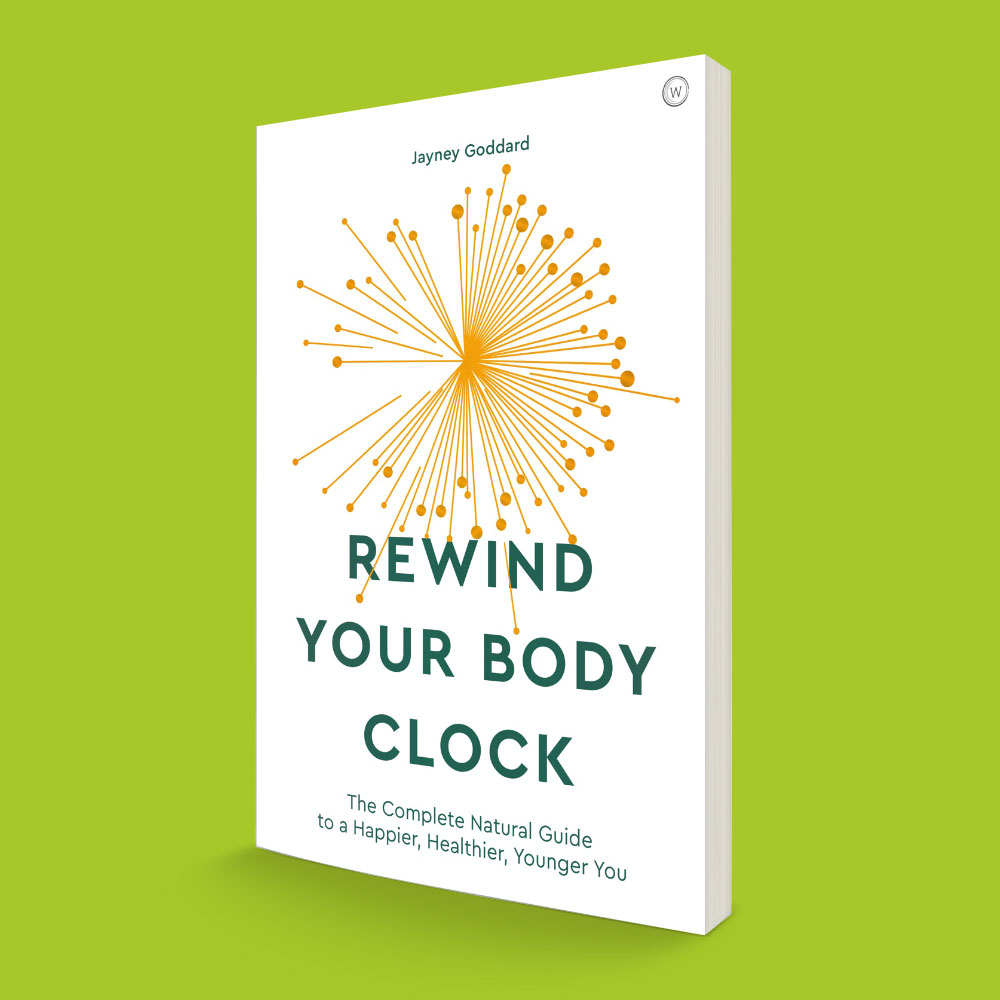

Reset Your Body Clock: 7 Powerful Ways to Thrive as the Clocks Go Back by Jayney Goddard, MSc, PGDip Ed, FCMA, FRSM President, the Complementary Medical Association
Here in the UK, on Sunday 25 October, at 2am, the clocks go back, and most of us gain an hour in bed. It feels like a gift, and in many ways it is. But the change also marks the start of something that matters far more for our long-term health: the slide into short days, dim mornings and long, artificially lit evenings.
Your body clock (your circadian rhythm) is the master timekeeper behind almost everything that keeps you vibrant: when you feel alert, when you feel sleepy, how well you handle the food you eat, how your hormones rise and fall, and even how your cells repair themselves overnight. It is the reason I called my latest book Rewind Your Body Clock, because when that inner rhythm is strong and well timed, so much else falls into place.
The wonderful news is that the research of the last few years has made one thing clear: the daily habits that keep your clock in tune are simple, low-cost and remarkably powerful. Here are seven of the best, ready for you to put into practice this autumn.
First, a Little Reassurance About ‘Falling Back’
You may have read alarming headlines about the clock changes. Most of those relate to the spring change, when we “spring forward’ and lose an hour. The autumn change is gentler. One large cardiology study from Michigan found that while the Monday after the spring change was linked to a 24% rise in heart attack admissions, the Tuesday after the autumn change saw a 21% fall, with no change in the overall number of heart attacks across the week.1
So the hour itself is not the real issue. The real issue is what comes next: four or five months in which many of us barely see daylight, then spend our evenings bathed in bright indoor light and screens. That is where your choices make the biggest difference.
1. Anchor Your Day With a Steady Wake Time to Reset Your Body Clock
If you take just one thing from this article, let it be this: consistency matters enormously. In a study of more than 60,000 UK Biobank participants who wore activity trackers, researchers measured how regular people’s sleep–wake timing was from one day to the next. Over the following six to seven years, those with more regular sleep had a 20–48% lower risk of dying from any cause, compared with the least regular group. They also had lower risks of dying from cancer and cardiometabolic disease. Strikingly, sleep regularity turned out to be a stronger predictor of mortality than sleep duration.2
This was an observational study, so it cannot prove cause and effect. But it tells us something liberating: you do not need a perfect eight hours every night. You need a rhythm. The easiest way to build one is to choose a wake time you can keep seven days a week, and to protect it. Your bedtime will tend to settle around it naturally.
Try this
Pick your wake time for the new clock now, and start living by it from Sunday 25 October, this genuinely will help to reset your body clock.
2. Ease Into the Change in 15-Minute Steps
When the clocks go back, 7am on the new clock feels like 8am to your body. Most people welcome that. But if you are naturally an early riser (and many of us become more so as we get older), you may find yourself wide awake at 5am, staring at the ceiling.
The simple fix is to shift gradually. Over the four nights before the change, move your bedtime and wake time about 15 minutes later each day. By Sunday, your body will already be living on the new time. A late-afternoon walk in natural daylight during those few days can help nudge your clock later too.
If you have left it until the weekend itself, simply wake at your chosen time by the new clock on Sunday morning, get outside early, and let daylight do the rest.
3. Chase the Daylight, Especially in the Morning
Light is the most powerful signal your body clock receives, and daylight is in a different league from indoor lighting. Even on a grey British morning, the light outdoors is many times brighter than a typical living room.
The evidence on this is growing fast. In 2024, researchers analysed light sensor data from nearly 89,000 UK Biobank participants, followed for around eight years. People who had the brightest days had a 17–34% lower risk of dying from any cause than those who spent their days in dim environments, with the strongest links seen for cardiometabolic deaths.3 A sister study from the same team, involving more than 85,000 people, found that brighter days were associated with a lower risk of depression and other mental health conditions.4
One of my favourite studies in this field sent volunteers camping in the Colorado Rockies for a week, with no electric light at all. Their internal clocks shifted around two hours earlier and lined up beautifully with sunrise and sunset. Even the self-confessed ‘night owls’ became more like larks.5
Try this
Aim for 20–30 minutes outdoors as early in the day as you can manage, without sunglasses (and never looking directly at the sun). A morning walk, coffee in the garden or a stroll to the shops all count. If mornings are impossible, get outside at lunchtime. Some daylight is far better than none.
4. Make Your Evenings Dim and Your Nights Truly Dark
The flip side of bright days is dark nights. In that same 89,000-person study, people exposed to the brightest light at night had a 21–34% higher risk of death than those in darker environments.3 Night-time light confuses your clock, telling your brain that it is still daytime.
You do not need bright light to have an effect, either. A Harvard study found that ordinary room lighting in the hours before bed suppressed melatonin, the hormone that signals night to every cell in your body, and shortened the time melatonin was released by around 90 minutes.6 Another study compared reading on a light-emitting tablet with reading a printed book before bed. The tablet readers took longer to fall asleep, produced less melatonin, had a delayed body clock, and felt less alert the next morning.7
Here is the encouraging part: bright days help protect you from evening light. Plenty of daylight appears to make your body clock less sensitive to light at night, so habits three and four work hand in hand.
Try this
- After dark, switch to lamps and warm, low lighting rather than bright overhead lights.
- Put screens away an hour before bed, or use night mode and lower the brightness if you can’t.
- Make your bedroom as dark as possible with blackout blinds or an eye mask.
- If you get up in the night, use a dim night light rather than switching on the main light.
5. Eat With the Sun
Your body clock does not live only in your brain. Your liver, gut, pancreas and muscles all have their own clocks, and food is one of the main signals that sets them. Eating late at night sends these organs a very different message from the one your brain is getting from the darkness.
Time-restricted eating, where you eat within a consistent daily window, has been studied as a way of bringing these clocks back into harmony. In a small 12-week study of people with metabolic syndrome, eating within a 10-hour window led to reductions in weight, blood pressure and harmful blood fats.8 I want to be honest that this was a pilot study without a control group, and other trials have produced more mixed results. Even so, the principle is sound and very gentle: eat most of your food during daylight hours, and give your body a long, restful overnight break.
Try this
As the evenings draw in, bring your evening meal a little earlier and make it lighter. Build it around vegetables, beans, lentils and whole grains, and aim for a 12-hour overnight gap between your last bite and breakfast. That is easy for most of us to achieve.
6. Time Your Movement to Work With Your Clock
Exercise is another powerful signal to reset your body clock, and timing matters. In a carefully controlled laboratory study, researchers asked 99 adults, half of them aged 59 to 75, to exercise at different times of day and night. Exercising at 7am, or between 1pm and 4pm, shifted their clocks earlier. Exercising between 7pm and 10pm shifted them later. Crucially, the results were the same for older and younger participants.9
That study used brisk treadmill walking, and we do not yet have equivalent data for strength training. But as you know, I believe resistance training is the single most important thing most of us can do for healthy ageing, so this is a wonderful reason to schedule your strength sessions in the morning or early afternoon. Better still, take your movement outdoors and you combine habits three and six in one go.
Try this
Plan your main workout of the day for the morning or early afternoon, and keep evening movement gentle: a stretch, some yoga or a slow walk after dinner.
7. Mind the Weekend Gap
Many of us live on one schedule during the week and quite another at weekends, staying up later and sleeping in to ‘catch up’. Chronobiologist Till Roenneberg calls this ‘social jetlag’, because it is rather like flying a couple of time zones west every Friday and back again every Monday. In his large population study, greater social jetlag was associated with a higher likelihood of being overweight.10
The darker months make this pattern especially tempting. Long evenings invite late nights, and dark mornings make it so easy to stay under the duvet.
Try this to reset your body clock:
Keep your weekend wake time within an hour of your weekday time. If you are tired, a short early-afternoon nap of 20 minutes or so is kinder to your clock than a long lie-in.
Bringing It All Together
None of these seven habits requires special equipment, expensive supplements or an overhaul of your life. They are about working with the natural rhythm your body has been tuned to for hundreds of thousands of years: bright days, dark nights, regular meals and movement while the sun is up.
The clocks going back is the perfect moment to begin. Choose one or two of these habits this week (I would start with a steady wake time and a morning walk) and build from there. Your energy, mood and sleep will thank you this winter. And over the years ahead, you will be investing in the thing that matters most: a long, vibrant healthspan.
Did you know…
I offer a personal 1-2-1 Concierge Service for people who want to go deeper with their health and longevity. Together, we create a longevity plan that is truly right and tailored just for you, from your daily rhythms and nutrition to movement, sleep and mindset.
Discover how to work with me through my 1-2-1 Concierge Service →
Frequently Asked Questions
When do the clocks go back in 2026?
In the UK, the clocks go back one hour at 2am on Sunday 25 October 2026, when British Summer Time ends and we return to Greenwich Mean Time.
Is the autumn clock change bad for your health?
The autumn change is generally easier on the body than the spring change, because we gain an hour rather than losing one. The bigger health challenge is the reduced daylight and increased evening light exposure that follow over the winter months.
How much morning light do I need to reset my body clock?
There is no single magic number, but 20–30 minutes outdoors in the morning is a practical and widely recommended target. Outdoor light is far brighter than indoor light, even on cloudy days.
Does it matter what time I go to bed if I get enough sleep?
Yes. Research from the UK Biobank suggests that sleeping and waking at consistent times may matter as much as, or even more than, the total number of hours you sleep.
Further Reading
About the Author
Jayney Goddard MSc, PG Dip Ed, FCMA, FRSM is the Founder and President of The Complementary Medical Association (The CMA), the world’s leading professional body for complementary medicine. With more than three decades at the forefront of complementary and integrative healthcare, Jayney has dedicated her career to raising professional standards across the sector and to championing rigorous, evidence-based natural approaches to health and longevity. She is the author of several best-sellers, including Rewind Your Body Clock – the Complete Natural Guide to a Happier, Healthier, Younger You (Watkins/Penguin Random House), which debuted on the Amazon charts at No. 1 among ALL books on the platform. Jayney is a sought-after international speaker and a passionate advocate for the safe, ethical integration of complementary medicine within mainstream healthcare. Through The CMA, she supports a global community of Practitioners, Fellows, and Approved Suppliers committed to the very highest standards of practice.
References
- Sandhu A, Seth M, Gurm HS. Daylight savings time and myocardial infarction. Open Heart. 2014;1(1):e000019. https://doi.org/10.1136/openhrt-2013-000019
- Windred DP, Burns AC, Lane JM, et al. Sleep regularity is a stronger predictor of mortality risk than sleep duration: a prospective cohort study. Sleep. 2024;47(1):zsad253. https://doi.org/10.1093/sleep/zsad253
- Windred DP, Burns AC, Rutter MK, et al. Brighter nights and darker days predict higher mortality risk: a prospective analysis of personal light exposure in >88,000 individuals. Proceedings of the National Academy of Sciences. 2024;121(43):e2405924121. https://doi.org/10.1073/pnas.2405924121
- Burns AC, Windred DP, Rutter MK, et al. Day and night light exposure are associated with psychiatric disorders: an objective light study in >85,000 people. Nature Mental Health. 2023;1(11):853–862. https://doi.org/10.1038/s44220-023-00135-8
- Wright KP Jr, McHill AW, Birks BR, et al. Entrainment of the human circadian clock to the natural light–dark cycle. Current Biology. 2013;23(16):1554–1558. https://doi.org/10.1016/j.cub.2013.06.039
- Gooley JJ, Chamberlain K, Smith KA, et al. Exposure to room light before bedtime suppresses melatonin onset and shortens melatonin duration in humans. Journal of Clinical Endocrinology & Metabolism. 2011;96(3):E463–E472. https://doi.org/10.1210/jc.2010-2098
- Chang AM, Aeschbach D, Duffy JF, Czeisler CA. Evening use of light-emitting eReaders negatively affects sleep, circadian timing, and next-morning alertness. Proceedings of the National Academy of Sciences. 2015;112(4):1232–1237. https://doi.org/10.1073/pnas.1418490112
- Wilkinson MJ, Manoogian ENC, Zadourian A, et al. Ten-hour time-restricted eating reduces weight, blood pressure, and atherogenic lipids in patients with metabolic syndrome. Cell Metabolism. 2020;31(1):92–104.e5. https://doi.org/10.1016/j.cmet.2019.11.004
- Youngstedt SD, Elliott JA, Kripke DF. Human circadian phase–response curves for exercise. Journal of Physiology. 2019;597(8):2253–2268. https://doi.org/10.1113/JP276943
- Roenneberg T, Allebrandt KV, Merrow M, Vetter C. Social jetlag and obesity. Current Biology. 2012;22(10):939–943. https://doi.org/10.1016/j.cub.2012.03.038
Medical disclaimer: This article is for general information only and is not a substitute for personalised medical advice. If you have a sleep disorder, a mental health condition, diabetes or any other medical condition, or if you take regular medication, please speak with your doctor or qualified healthcare practitioner before making changes to your sleep, diet or exercise routine.