Digestion is a series of physical and chemical changes by which food that is taken into the body is broken down in preparation for absorption from the intestinal tract into the bloodstream.
These changes take place in the gastrointestinal tract, which includes the mouth, esophagus, stomach, and small and large intestines.
The active materials in the digestive juices that cause the chemical breakdown of foods are called enzymes, combinations of amino acids that are capable of inducing chemical changes in other substances.
They are highly specialised – for example, an enzyme that breaks down fats can’t break down proteins or carbohydrates.
Enzymatic action originates in five areas of the body: The salivary glands, stomach, pancreas, liver and the wall of the small intestine.
Carbohydrates, fats and proteins – the three types of energy- yielding nutrients – are dependent on the enzymes, which break them down into basic components that can be absorbed for use by the body.
Digestion begins when chewing breaks large pieces of food into smaller pieces.
The salivary glands in the mouth produce saliva, which contains water, salts, and enzymes that moisten food for swallowing and prepare it for digestion.
Saliva also protects the tooth surfaces and linings of the mouth, esophagus and stomach from attack by molecules that might harm them. Enzymes released in the mouth do not affect the fats, proteins, vitamins, minerals, and fibers that are present in foods; however, an enzyme called salivary amylase begins the breakdown of carbohydrates.
Once a mouthful of food has been swallowed, it is called a bolus. This masticated mass passes back to the pharynx under voluntary control, but from then on, and through the entire body, the process of moving food substances downward is called peristalsis.
This automatic action involves a slow, wavelike motion that happens along the entire gastrointestinal tract.
When the food passes into the stomach’s entrance, a bank of muscle called the cardiac sphincter contracts and closes so that the bolus can’t slip back.
Active chemical digestion begins in the middle portion of the stomach where food is mixed with gastric juices containing hydrochloric acid (HCl), water, and more enzymes that break up protein and other substances.
It is here that the stomach acid kills bacteria that can enter the body along with the food; the cells of the stomach wall protect themselves from this same acid by secreting a mucus that coats the stomach’s lining.
The major digestive accomplishment of the stomach is initiating the breakdown of proteins. This is achieved by the enzyme pepsin and the stomach acid itself, both of which act as catalysts.
Lesser actions are the digestion of some fat and, to a small extent, sucrose by stomach acid as well as the secretion of intrinsic factor, necessary for the absorption of Vitamin B12. Intrinsic factor is a glycoprotein made in the stomach.
After one to four hours, depending on the combination of foods eaten, peristalsis pushes the bolus, which is now in the liquid form of chyme, out of the stomach by means of the pyloric sphincter and into the small intestine. By this time the digestion of all three of the energy-yielding nutrients has begun. They leave the stomach in the following order: Carbohydrates, proteins, and fats, which take the longest to break down.
When chyme enters the small intestine, the pancreas secretes its digestive juices.
Bile, produced by the liver, and stored in the gallbladder, is secreted if fats are present.
This digestive aid is an emulsifier, not an enzyme, that separates the fat into small droplets so pancreatic enzymes can break it down for absorption.
The pancreatic juice that enters through the common bile duct contains enzymes that continue the breakdown of proteins and carbohydrates; it also contains sodium bicarbonate, which neutralises the acidic chyme.
After the absorption of the available nutrients, the remaining undigested products enter the large intestine by means of the ileocecal valve, another sphincter. No digestive enzymes are secreted here, but the bacteria present in the large intestine produce vitamin K, which is also absorbed in this section of the gut. Other bacteria in the large intestine guard against certain diseases.
The leftover residue that enters the large intestine includes some fibers that are not absorbed but continue through the colon, providing a semisolid mass that helps stimulate the muscles of the gastrointestinal tract to perform peristalsis efficiently.
This fibre incorporates bile acids, sterols (including cholesterol) and fat, and it also holds water, keeping the stool soft. The strong muscles of the rectum hold back this semisolid waste until it is time to defecate. The muscles then relax and the last sphincter, the anus, allows the waste to pass.
The many components of the digestive process
Some of the most important ones are:
– Amylase – an enzyme that breaks down amylose, a form of starch.
– Bicarbonate – occurs widely in all cell fluids; secreted by the pancreas and passed into the intestine through the common bile duct.
– Bile – an exocrine secretion of the liver stored in the gallbladder, made from cholesterol that emulsifies fats.
– Carbohydrase – an enzyme that breaks down carbohydrates.
– Gastric glands – exocrine glands in the stomach wall that secrete gastric juice into the stomach.
– Gastric juice – rennin (curdles milk protein, which readies it for pepsin action), pepsin (for protein), and lipase (for emulsified fats) secreted by the gastric glands out of the stomach wall).
– Intestinal juice – secretion of the intestinal glands, contains the enzyme for the digestion of carbohydrate and protein and a minor enzyme for fat digestion.
– Lipase – an enzyme that breaks down lipids (fats).
– Mucus – a relative of carbohydrate that is secreted outward by the cells in the stomach wall (mucous membrane).
– Pancreatic juice – contains enzymes for the digestion of carbohydrates, fat, and protein, which is secreted into the small intestine (the production of insulin, a hormone that facilitates the uptake and use of blood sugar and other hormones, is also a function of the pancreas).
– Pepsin – a protein-digesting enzyme that secretes out of the stomach wall.
– Protease – an enzyme that breaks down protein.
Absorption
Absorption is a process by which nutrients are taken up by the intestines and passed into the bloodstream to facilitate cell metabolism.
Within three to four hours after a meal has been eaten, the body must find a way to absorb millions of nutrient molecules including amino acids (proteins), monosaccharides (carbohydrates), fatty acids, glycerol and monoglycerides (fats), vitamins, and minerals.
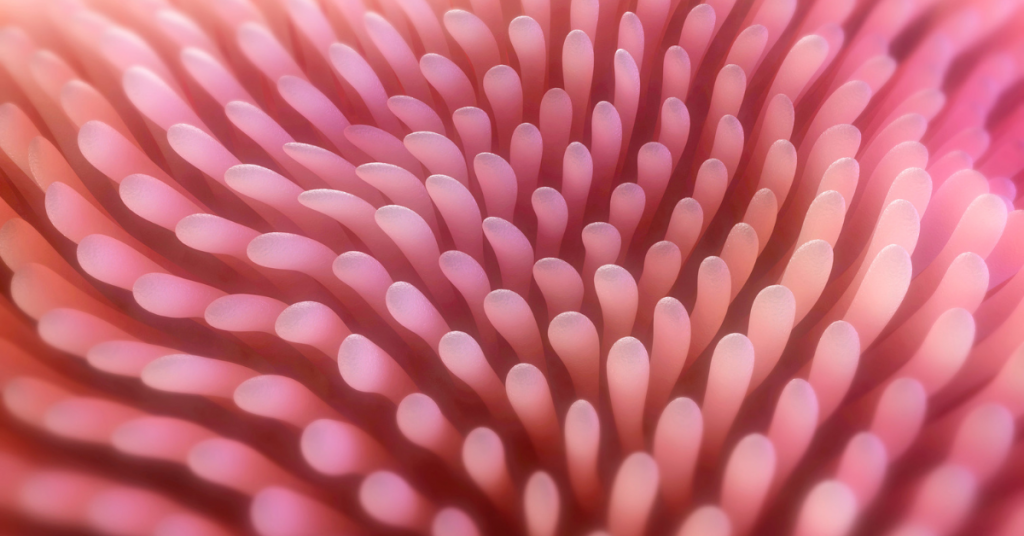
Absorption takes place primarily in the small intestine, which has a surface area comparable to a quarter of a football field and a length of twenty feet. The surface is wrinkled into hundreds of folds that are covered with small finger-like projections called villi. A single villus magnified is composed of several hundred cells, each covered with several microscopic hairs called microvilli.
These villi are in constant motion. Any nutrient molecules small enough to be absorbed are trapped in the microvilli and are drawn into the cells underneath and absorbed. Some partially digested nutrients from the stomach are also caught in the microvilli, digested further by enzymes, and absorbed into the cells.
The cells of the three portions of the small intestine (duodenum, jejenum, and ileum) are specialised to absorb different nutrients. Nutrients that are readily available (broken down or water soluble) are absorbed near the top of the tract while those that take longer to be digested are absorbed farther down.
The duodenum is specialised to absorb calcium, vitamin A and the B vitamins thiamin and riboflavin.
Fats are mostly absorbed by the jejunum, and vitamin B12 is absorbed by the ileum.
The process of chelation combines minerals and amino acids for increased absorption.
Once a molecule has entered a cell in a villus, it may enter either the vascular or the lymphatic system of transport. The water-soluble nutrients (including the smaller products of fat digestion) move into the vascular system from the cells under the villi by way of capillaries.
Blood, pumped in a figure-eight pattern throughout the body, directly picks up the nutrients through a portal vein that goes straight to the liver. Blood leaving the liver transports some of these nutrients to the heart by way of the hepatic vein while other nutrients are stored or used within the liver.
The heart then pumps the nutrients in the blood to wherever the body needs them. The liver is well located within this system of circulation so that it will have the first chance to screen all products absorbed from the intestinal tract and guard against any harmful agents that may try to invade the body.
Unlike those entering the vascular system, the larger fats and fat-soluble vitamins that are transported by the lymphatic system do not go to the liver first; they go to the heart. For these nutrients, direct access into the blood is impossible because they are both too big and insoluble in water, which is the main component of blood.
Their eventual entrance into the bloodstream is by a one-way route through the liquid spaces between the cells; the nutrients move from one section to another as muscles contract and push them into a large duct (thoracic) behind the heart.
This duct ends in a vein (subclavian) that can accept the nutrients and moves them into the bloodstream and the heart for distribution. The body’s cells remove the parts they can use. The final stop is the liver, where whatever is left is reassembled to agin enter the bloodstream.
In the liver, many different enzymes help change the nutrient molecules into new substances for specific purposes. Unlike digestion, which prepares nutrients for absorption and transport, the reactions in the liver produce the end products needed by individual cells to give us healthy bodies.
Food broken down into its component parts during digestion is absorbed via the bloodstream. Water-soluble vitamins also take this route.
Fat – soluble nutrients enter via the lymphatic system.
The basic nutrients – carbohydrates, fats, proteins, vitamins, minerals, and water – are each digested in a specific way depending on what is required for absorption and elimination of the substance.
Dietary fibre
Dietary fibre is that which remains after food is digested and is not a nutrient.
Mouth – teeth crush fibre to mix with saliva, readying it for swallowing.
Stomach – fibre adds bulk to food.
Small intestine – fibre binds minerals such as bile salts used by the body to prepare fat for absorption.
Large intestine – most fibre passes untouched through the digestive tract and goes to the large intestine, where bacterial enzymes digest hemicellulose into glucose, which is absorbed. Dietary fibres exercise intestinal muscles so they retain their health and tone. Cholesterol and some minerals are bound and excreted with fibre.
Carbohydrates
Starch and sugar are carbohydrates.
Mouth – salivary gland excretes the enzyme salivary amylase, beginning the digestion of starch to polysaccharides and maltose.
Stomach – acid and enzymes start to digest salivary enzymes, stopping the digestion of starch. Maltose and sucrose are partially broken down by the stomach acid.
Small intestine – carbohydrase is released by the pancreas, which breaks polysaccharides into maltose. Enzymes on the surface cells of the small intestine break down the polysaccharides into disaccharides and then to monosaccharides, which are absorbed through the cells and into the bloodstream.
Large intestine – no absorption of carbohydrates takes place.
Fats
Fats include triglycerides (fats and oils), phospholipids (lecithins), and sterols (cholesterol, vitamin D and the sex hormones).
Mouth – lingual lipase is secreted, and fats melt as they reach body temperature.
Stomach – triglycerides are split into diglycerides.
Small intestine – bile from the liver flows through the common bile duct to emulsify the fat. Pancreatic lipase breaks down the emulsified fat into monoglycerides, glycerol and fatty acids for absorption.
Large intestine – some fat and cholesterol remain in the faeces.
Proteins
Proteins are amino acids linked into chains.
Mouth – protein foods are chewed and made ready to swallow.
Stomach – acid undoes protein strands, and enzymes are activated. Proteins become smaller polypeptides.
Small intestine – polypeptides are split by pancreatic and small intestine enzymes. More enzymes on the surface of the intestinal cells hydrolyse the peptide and then absorb the amino acids.
Large intestine- no absorption of protein takes place.
Vitamins
Vitamins are organic, essential nutrients that are required in minute amounts and yield no energy.
Mouth – no action takes place in vitamins in the mouth or esophagus.
Stomach – intrinsic factor (a necessary compound for absorption) attaches to vitamin B12.
Small intestine – fat-soluble vitamins are emulsified by bile and are absorbed with other fats as well as the water-soluble vitamins.
Large intestine – vitamin K, produced by bacteria, is absorbed.
Minerals and Water
Minerals are small inorganic molecules that yield no energy. Water is also inorganic and yields no energy.
Mouth – water is secreted with saliva to integrate and bind food.
Stomach – acid (HCl) reduces iron for absorption. The stomach secretes watery fluid to turn moist, chewed food into watery chyme.
Small intestine – the pancreas, liver and small intestine add enough fluid that the total secreted into the intestine in a day is approximately 2 gallons.
Minerals are absorbed. Calcium is provided with vitamin D to be properly absorbed.
Large intestine – the remainder of the minerals and more water are absorbed.
Metabolism
Once absorbed, the handling of food within the body has reached its final stage.
The process of metabolism involves all the chemical changes that nutrients undergo from the time they are absorbed until they become a part of the body or are excreted. Metabolism is the conversion of the digested nutrients into components for energy or for building material for living tissue.
The basic units of metabolism are:
Glucose – from carbohydrates
Glycerol – from fats
Fatty acids – from fats
Amino acids – from proteins
Factors inhibiting Digestion and Absorption
The gastrointestinal tract is sensitive and responsive to conditions within the environment. The movements of the stomach can be interfered with by nervousness and anxiety. Eating while agitated, fatigued, or worried may give rise to gastrointestinal disturbances. In a person under stress, digestive secretions are reduced and the blood is routed to the muscles more than to the digestive tract. This action impairs efficient absorption of nutrients.
To digest and absorb food best, one should be relaxed and tranquil at mealtimes. Hurried meals under tense conditions are not beneficial to healthy digestion.
Weather variations and physical disorders also may inhibit normal digestion.